Reading difficulty is rarely one-dimensional. Two of the most common — and most overlooked — contributors are underdeveloped visual skills and inefficient reading patterns. Together they affect a substantial share of students at every grade level, and standard literacy assessments don’t screen for either one.
STF’s free pilot program gives your school or district the tools to see what’s actually holding students back — and to act on it. Here’s what participating schools and districts gain.

Earlier Identification, Earlier Impact
Visual and reading efficiency barriers are far easier to address before inefficient habits and compensatory strategies become automatic. Screening early means earlier intervention — and a significantly better chance of lasting improvement.
More Diagnostic Precision, Less Wasted Spend
Knowing why a student struggles means matching that student to the right support the first time. That reduces misclassification, over-referral to special education, and Tier 2-Tier 3 dollars spent on interventions that can’t reach the actual cause of the difficulty.
Built for the Classroom Teacher
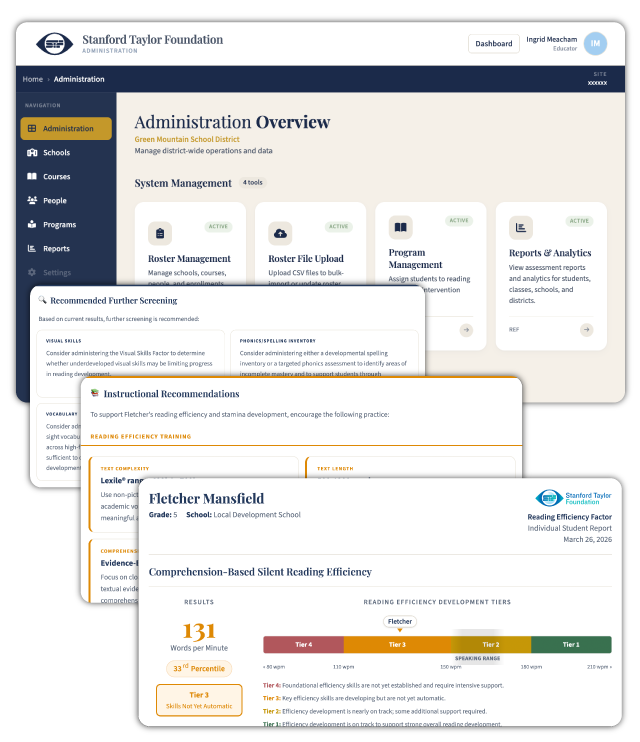
Every assessment is brief and requires no specialist training to administer. Outputs are tiered risk profiles with specific, actionable next steps — not raw scores or technical reports that require interpretation. Teachers get what they need to act.
Integrates With Your Existing Instruction and Systems
The STF screeners are built to layer into existing MTSS/RTI workflows and interface with the data platforms and literacy screeners your district already uses. This is a complement to your existing assessment system, not a replacement for it.
Low Burden, Measurable Results
Reading efficiency training takes 15–20 minutes, two to five days a week — in the classroom or as homework. Visual skills development activities are designed to integrate naturally into foundational literacy instruction at early grades. The lift is small; the payoff is real.
Longitudinal Data Built In
The platform captures subgroup performance, growth trajectories, and screening-to-outcome data over time — giving your team the evidence needed to demonstrate impact as a standard part of operations, without waiting on periodic external studies.
Minimal IT Lift
The tools are designed for standard K–12 roster management and single sign-on (SSO) protocols, with exports that work with the data platforms your district already runs. Your IT team can deploy it without custom work or new infrastructure.
Ready to Learn More?
Fill out the form and an STF team member will reach out to walk you through the details — no obligation.