Can you understand what you are looking at?
As part of the meaning-making process, we transform visual images into mental images. To achieve this we involve our memory, our visualization capabilities, and connect background knowledge.
However, distorting the visual input phase can greatly hinder, or even prevent, the meaning-making process, regardless of a student’s adequate intellectual capabilities.
Limitations of acuity impact visual processing. This acuity peaks in the fovea (the central 2° of a fixation). Vision loses clarity in the parafovea (which extends out to 5° on either side of fixation) and degrades even further in the perifovea and periphery (the regions beyond the parafovea) (Iwasaki & Inomata, 1986; Rayner, 1998). This means that we end up with an average perceptual span (i.e., the number of letters a person can perceive and process during a single eye stop (fixation)) that includes about four to six letters to the left of the fixation point and about eight to twelve letters to the right. This is the extent to which we can see crisply. Beyond this area, we are relying on word shape information.
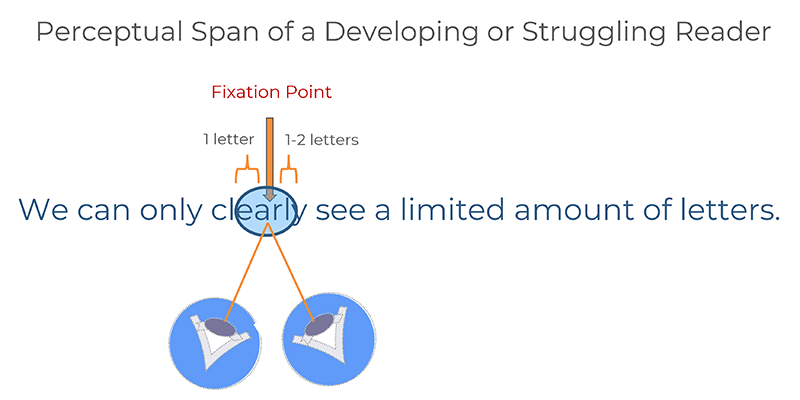
The average perceptual span of beginning readers and of most people who struggle with reading is smaller than the span of efficient readers (Rayner, 1986). This means that efficient readers perceive larger word impressions per fixation, which contributes to automaticity in word recognition and paves the way for more efficient text navigation and streamlined visual processing.
Perceptual Span of Efficient and Inefficient Readers